



When we talk about high-rise work and vertical work, we often wonder if they are the same thing or not. In today's article, we'll make it a bit easier for you and help you identify the differences to understand what we mean by high-rise work vs. vertical work.
What are high-rise works considered?
When we refer to "high-rise works", we are talking about a set of procedures that take place at a height of 2 meters or more from the ground and where there is a risk of falling and harmful consequences for the technician who performs them (it could even result in death). For this reason, it is really important to have the correct personal protective equipment (PPE) for this type of work. Some examples of situations where you can carry out high-rise work are:
- Roof or cover work: tasks that require important planning to avoid accidents.
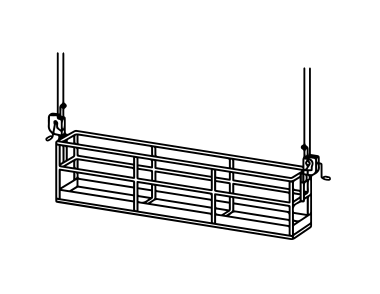
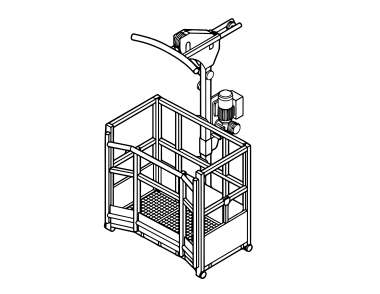
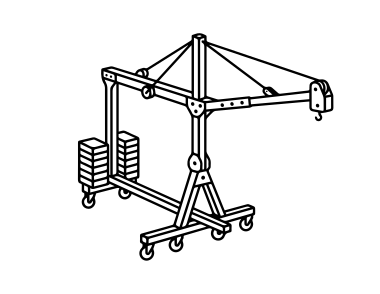
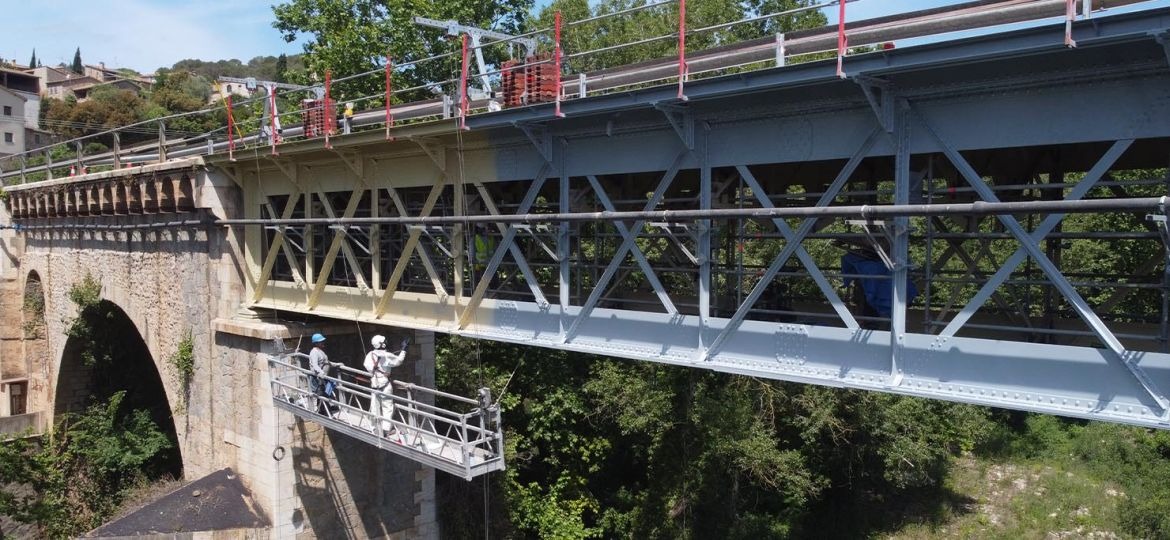
- Work with tubular scaffolding (fixed structures on the ground) or hanging scaffolding (structures suspended at great heights).
- Work on ladders: which can be extendable or scissor-type.
- Work on elevating platforms: which serve to move workers.
These different work methods are often used for maintenance, cleaning, repair, and rehabilitation tasks of existing buildings or new constructions and large projects. In addition to having certification for high-rise work, the technician is often required to have additional certifications for the correct use of the equipment they will use.
As we mentioned earlier, these jobs involve a significant risk for the technician and must be performed with the so-called "safety kit" adequate, which includes the necessary individual protections to safely protect the worker. It is necessary that these teams have an anti-fall system (PPE), that allows the technician to have their hands free to work and, at the same time, maintain their safety in the face of possible falls that put their life at risk. It is also important to emphasize that prior training to perform this type of work is key to acquiring the basic and necessary knowledge that allows the technician to work with total confidence and security, such as the course taught by Gravitat on high-rise work, located in Barcelona.
What do we mean by vertical work?
With this term, we identify those jobs that use a series of rope access and positioning techniques in hard-to-reach places. This type of work allows the technician to perform different maneuvers to access the workplace when the use of machinery is practically impossible. Although for this type of maneuver, it is essential to have specific training in vertical work, which can be simply a basic training of 3 days, or if you want to be a technician with a higher degree of experience and with more job opportunities, you can obtain your IRATA certification, which is the highest standard of safety for working suspended from ropes.
The main difference between a vertical job and a high-rise job is the use of ropes by the technician to access the work area. In vertical work, you work with at least two ropes, which provides greater safety for the technician or worker. The first of these ropes is known as the "work rope" and is used as a means of ascent, descent, and support. On the other hand, the second rope is known as the "safety rope" and is used as reinforcement in case of any damage or unforeseen event with the first rope. In some cases, there are jobs that must be performed by handling loads, so it is necessary to add a third rope that can serve as support for the technician to move the load without running any danger and can develop the work in the most appropriate way.
The technician needs to use specific material to develop an effective and safe job. Among the necessary material, the following can be highlighted: blockers, suspension harnesses, ropes, anchor points, helmets, among others.
What protection equipment will we use in each case?
The A600 harness would be a very good example of a harness for high-rise work, as it is a high-end harness with padding, breathable vest, lightweight automatic buckles, and fall indicators. It is a very complete harness that fulfills the anti-fall function thanks to the dorsal and frontal anchor points, as well as the retention function for its anchor points for positioning on rails. All of this makes it ideal for equipping operators in high-rise work at more than 2 meters, such as in hanging scaffolding, ladders, covers, wells, or vehicles.
On the other hand, mentioning the A71 as a very complete and competitive harness for those users who perform suspended work, such as vertical workers who work in the construction, cleaning, and rehabilitation of buildings or arboriculture or pruning jobs. The A71 suspension harness has 2 anchor points (dorsal and frontal) and the suspension anchor point for working in a seated position. It also has a pair of lateral anchor points located on the belt that would fulfill the positioning function and several tool holders ideal for attaching all types of work tools to the belt and preventing their fall when working at height.
And to complete the safety equipment for your high-rise or vertical work, from Accesus, we have a wide range of anti-fall slings (simple, double, elastic, with a load capacity of up to 140 Kg and short with minimum fall distance), retractable anti-fall devices, connectors, anchor points, tool holders, and transport bags to equip you with total security to perform your high-rise and/or vertical work.
Note: Article in collaboration with the GRAVITAT training center.