













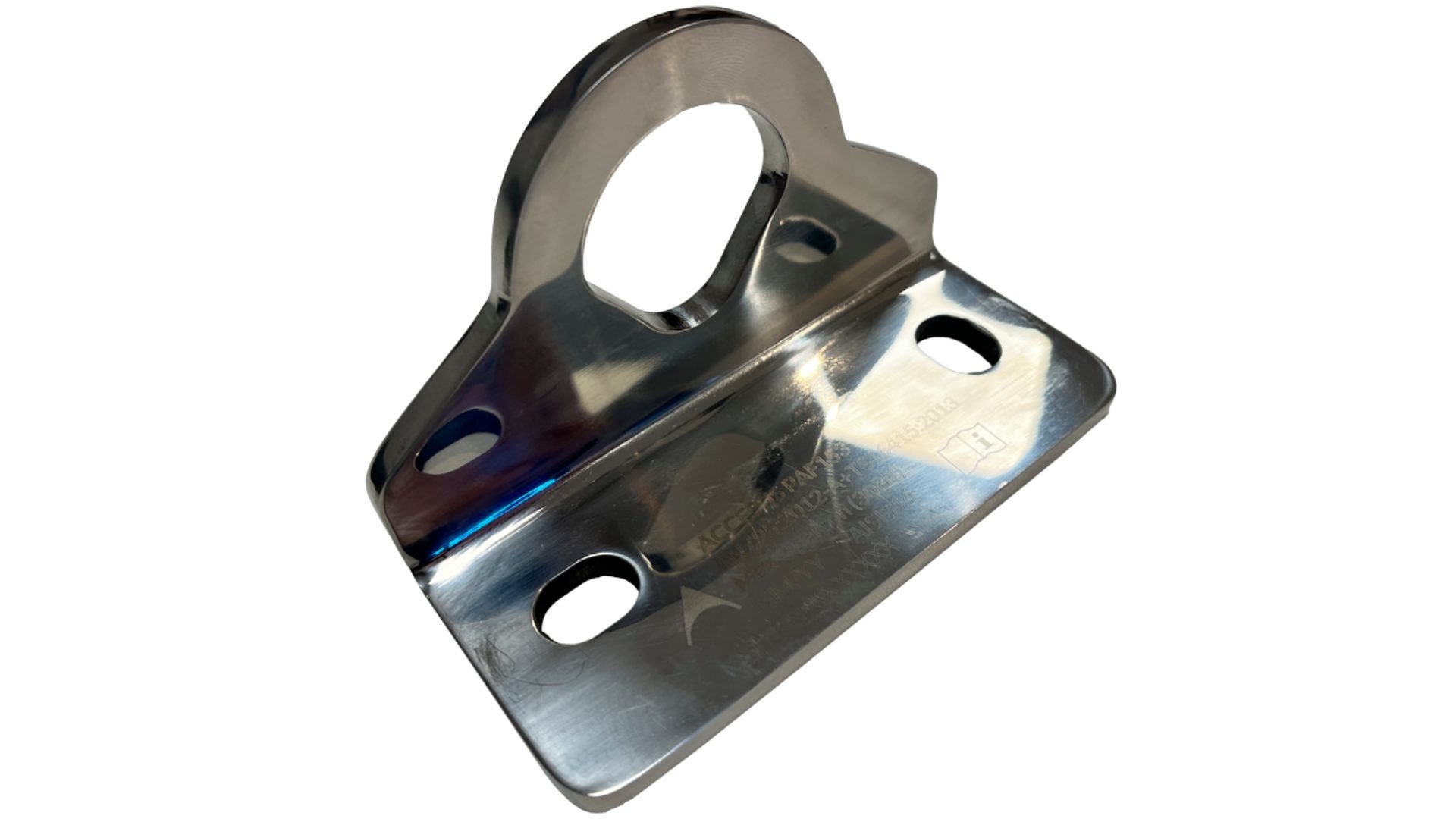
In the field of height safety, the evolution of equipment not only involves increasing their mechanical performance but also improving their versatility, ergonomics, and adaptation to real work scenarios. In this context, Accesus presents the new PAF153 anchor point, a revised version that maintains high levels of resistance and provides clear improvements in design, weight, and functionality.
The PAF153 offers a resistance of 30 kN in all directions of load, a value fully compatible with the requirements of Accesus horizontal lifelines and consistent with the loads generated in the event of a fall. 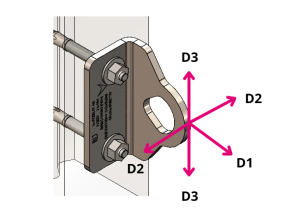
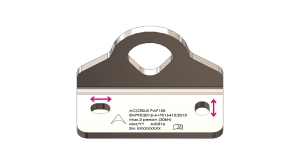
In addition, its new design incorporates slots in the X and Y directions, allowing for greater flexibility in installation and facilitating the adaptation of the anchor point to different structural configurations.
These improvements are complemented by a significant reduction in weight, from 1.1 kg in the previous version to 0.75 kg, which simplifies handling and installation on site. Finally, the PAF153 is certified according to the CEN/TS 16415:2013 technical specification, enabling its use by up to three users simultaneously, significantly expanding its application possibilities compared to models certified only according to EN 795, which only allows use by one user.
Next, we analyze in detail the compatibility of the PAF153 anchor point with the different Accesus horizontal lifelines and the technical criteria that must be taken into account for a safe installation.
As we saw in the article Compatibility between the PAF150 anchor point and Accesus lifelines: what you need to know, the first thing we must consider are the elements that influence a lifeline system.
First, before installing a horizontal lifeline system, it is essential to understand the factors that influence its behavior in the event of a fall. The main parameters to consider are the following:
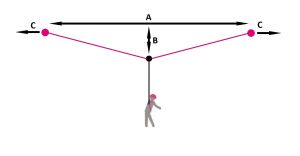
- A: The length of the lifeline that the user wants to install.
- B: The maximum deflection or vertical deviation in the event of a fall. In other words, it would be the deformation that the lifeline undergoes due to the impact of a fall.
- C: The forces transmitted to the anchor points when the fall is stopped.
Understanding these concepts is key to correctly evaluating the compatibility between an anchor point and a lifeline. Knowing these concepts and after analyzing the resistance values of the PAF153 anchor point, it can be stated that this is compatible with the following horizontal lifelines: LVH300-20+CONECTORES, LVH321, LVH320 and LVH400. The compatibility is based on the fact that the PAF153 has a resistance of 30 kN in all directions of load, which allows its integration into lifeline systems without the need to condition its use to a specific orientation with respect to the direction of force.
What is the "direction of load"?
In the tests carried out, the PAF153 anchor point was subjected to loads applied in different directions, which are defined as D1, D2, and D3, corresponding to the X, Y, and Z axes in a three-dimensional space.
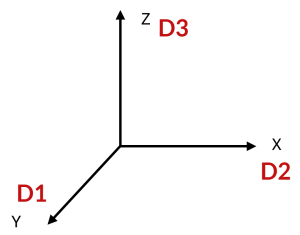
Unlike other anchor points, the PAF153 offers the same level of resistance regardless of the direction of load application, as shown in the following table:
| Load direction | Maximum resistance (kN) |
| D1 | 30 |
| D2 | 30 |
| D3 | 30 |
This behavior eliminates one of the main limitations common in the design of lifeline systems and provides greater flexibility in installation.
Analysis by lifeline model
Lifeline LVH300-20 + CONECTORES
In the case of the LVH300-20 + CONECTORES lifeline, the forces transmitted to the anchors are indicated in the user manual in the "C (kN)" column.
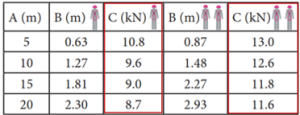
As indicated in the user manual, the usual safety margin must be applied, multiplying the maximum forces generated by two (2). This calculation is not exceptional or excessively conservative: it is part of the design and verification of any anchor system that complies with the regulations. From this adjustment, the following results are obtained:
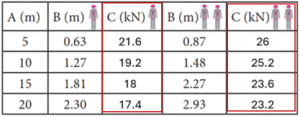
Once this margin is applied, the resulting loads remain below 30 kN, so the PAF153 anchor point is compatible with this system, regardless of the direction of load. Technical conclusion: the PAF153 + LVH300-20 + CONECTORES set is safe without orientation restrictions.
Lifeline LVH321
For the LVH321 lifeline, the load tables indicated in the user manual already include the applied safety margin.

As can be seen in the columns of the generated loads (F(kN)), for a single user, the forces transmitted to the anchor are less than 30 kN, regardless of the length of the lifeline. The same happens for two or three users; the maximum loads generated are also kept within this value. Technical conclusion: the PAF153 anchor point is compatible with the LVH321 lifeline for one, two, or three users, without limitations by load direction.
Lifeline LVH320
In the LVH320 lifeline, the load values indicated in the "F (kN)" column already include the required safety margin.
<img class="alignnone wp-image-53082" src="https://www.accesus.es/wp-content/uploads/2026/03/tabla_LVH320-1024x