
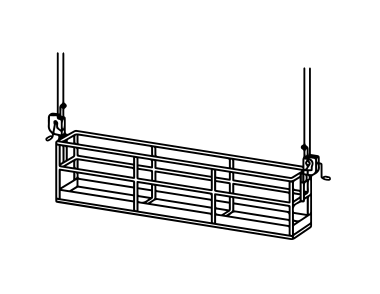
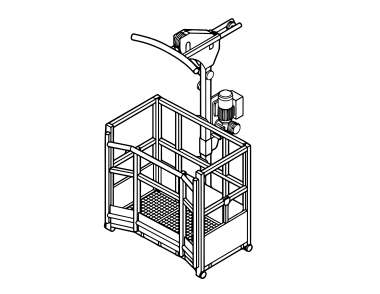
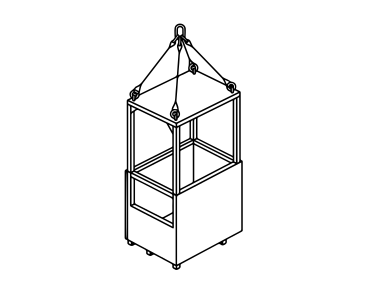
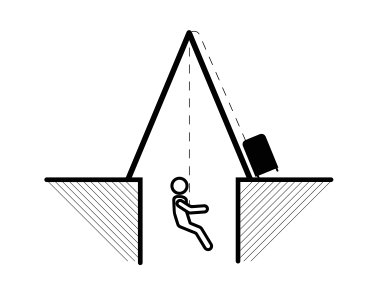

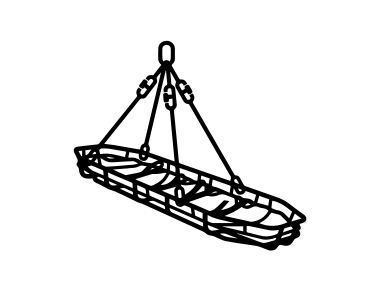









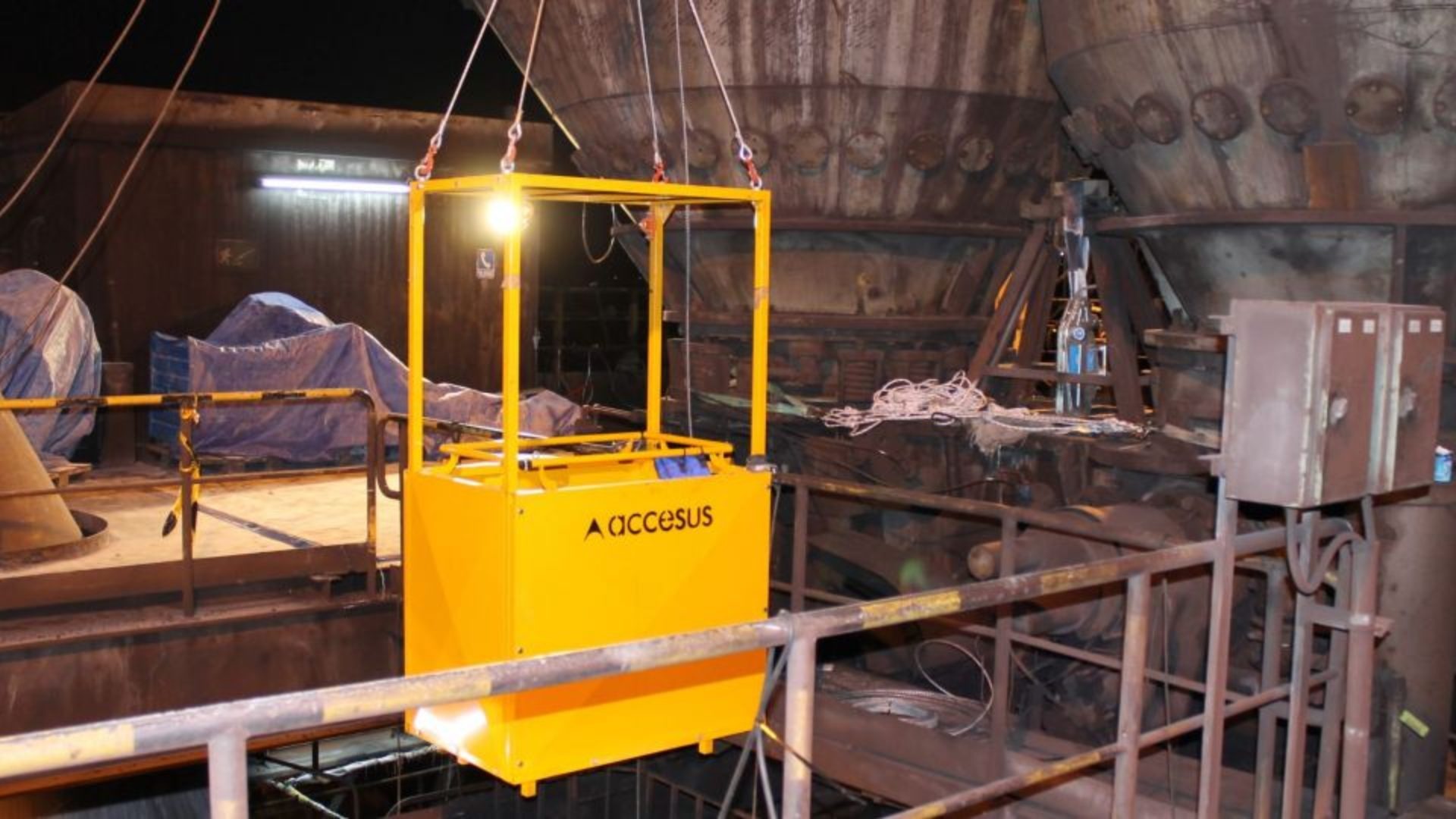
Many of you frequently ask us about the use of crane-suspended baskets.
Although this is a widely used piece of equipment and commonly seen in construction and industrial settings, it raises many questions regarding its use and application.
Recently, we addressed the question: can a crane basket carry CE marking?
In this article, we will briefly explain the regulatory use of this equipment, when it can be used and when it cannot.
Regulatory framework for crane-suspended baskets
It is important to understand that the use of any work equipment, and in particular lifting equipment (such as cranes), is governed by Royal Decree RD1215/1997 of 18 July, which establishes the minimum health and safety requirements for the use of work equipment by workers.
In Annex II, we find the following clarifications:


General conditions for the use of work equipment:
- Work equipment must not be used in a manner, for operations, or under conditions contraindicated by the manufacturer. Nor may it be used without the protective elements required for the specific operation.
- Work equipment may only be used in a manner, for operations, or under conditions not considered by the manufacturer if a prior risk assessment has been carried out and the appropriate measures have been taken to eliminate or control them
Conditions for the use of work equipment for lifting loads:
General provisions:
The lifting of workers shall only be permitted using work equipment and accessories designed for that purpose.
In addition, Royal Decree RD 1627/1997 of 24 October, which establishes minimum health and safety requirements for construction sites, includes further considerations.
In Annex IV, PART C, it states:


Lifting equipment:
Lifting equipment, as well as its accessories, must not be used for purposes other than those for which they are intended.
Installations, machines and equipment:
Installations, machines and equipment, including hand tools whether powered or not, must:
Be used exclusively for the tasks for which they have been designed.
Based on what we have seen so far, it is clear that both decrees prohibit the use of cranes to lift suspended baskets because:
- A crane is not equipment designed for this purpose.
- A crane designed for lifting loads cannot be used for lifting people.
Exceptions for the use of crane-suspended baskets
In the same Annex II of RD1215/1997 mentioned above, the conditions are set out that must be met when, exceptionally, work equipment not designed for lifting people is used for that purpose:


Conditions for using work equipment to lift loads
General provisions
However, where, exceptionally, work equipment not designed for this purpose must be used, appropriate measures must be taken to ensure worker safety and adequate supervision must be provided.
While workers are on equipment intended for lifting loads, the control position must be continuously attended. Lifted workers must have a reliable means of communication, and arrangements must be in place for their evacuation in case of danger.
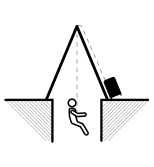
Therefore, a crane may exceptionally be used to lift a suspended basket with people. But what does exceptional use mean? Let us examine possible cases in the following section.
CONDITIONS FOR EXCEPTIONAL USE OF CRANE BASKETS
Routine, repetitive or foreseeable operations, for which a tailored solution can be planned and designed, cannot be considered exceptional conditions.
In these situations, it is always safer to use a platform designed for this function, following a predefined work procedure supervised by a competent person. Therefore, the following are NOT considered exceptional cases:
- Lifting people from one level to another
- Repair of public or private lighting
- Access to storage areas for order preparation
- Manual handling of materials at height
- Installation, assembly or dismantling operations at height
- Other work at height, even occasional, such as cleaning, maintenance, etc.
However, the following may be considered exceptional situations, and therefore non-routine and non-repetitive:
- It is technically impossible to use equipment designed for lifting people.
- The risks arising from the work environment are greater than those associated with using load-lifting machines adapted for lifting people.
- An emergency exists, such as the need to evacuate people or carry out an immediate repair to prevent a possible accident.
It is important to note that the competent labour authority is responsible for defining and/or authorising such exceptional use. Under no circumstances is the equipment manufacturer authorised to do so.
Furthermore, it is evident that, in addition to using the equipment correctly, all appropriate safety measures must be taken. In future publications, we will provide more information about crane-suspended baskets and the safety measures to consider for their use.

What does the regulation say?
- Crane-suspended baskets cannot be used for routine or repetitive work.
- Their use is only permitted on an exceptional basis.
What does exceptional use mean?
- When it is technically impossible to use another solution.
- When the risks of not using a suspended basket are greater than those associated with an alternative solution.
- In the event of an emergency.


Useful links
Royal Decree RD1215/1997 of 18 July
Royal Decree RD 1627/1997 of 24 October
FT-373 Technical note for crane-suspended baskets.